Tirreno
Cliffs · Grottos · Drama
Ionio
Sands · History · Light
Italy's Untamed South
Calabria
780 kilometres · Two seas · Eight coasts
One extraordinary region
Explore
Italy's Untamed South
780 kilometres · Two seas · Eight coasts
One extraordinary region
The Art of the Undiscovered
Calabria is geographically unique — a peninsula within a peninsula, battered by two seas with profoundly different characters. The Tyrrhenian west is all drama: granite cliffs, sea caves, cliff-perched towns and waters that turn violet at sunset. The Ionian east is openness: wide sand plains, ancient Greek ruins buried beneath the surface, and Marine Protected Areas sheltering sea turtles and seahorses. Click any location below to explore.
Beaches, flavors, history — each coast has its own story.
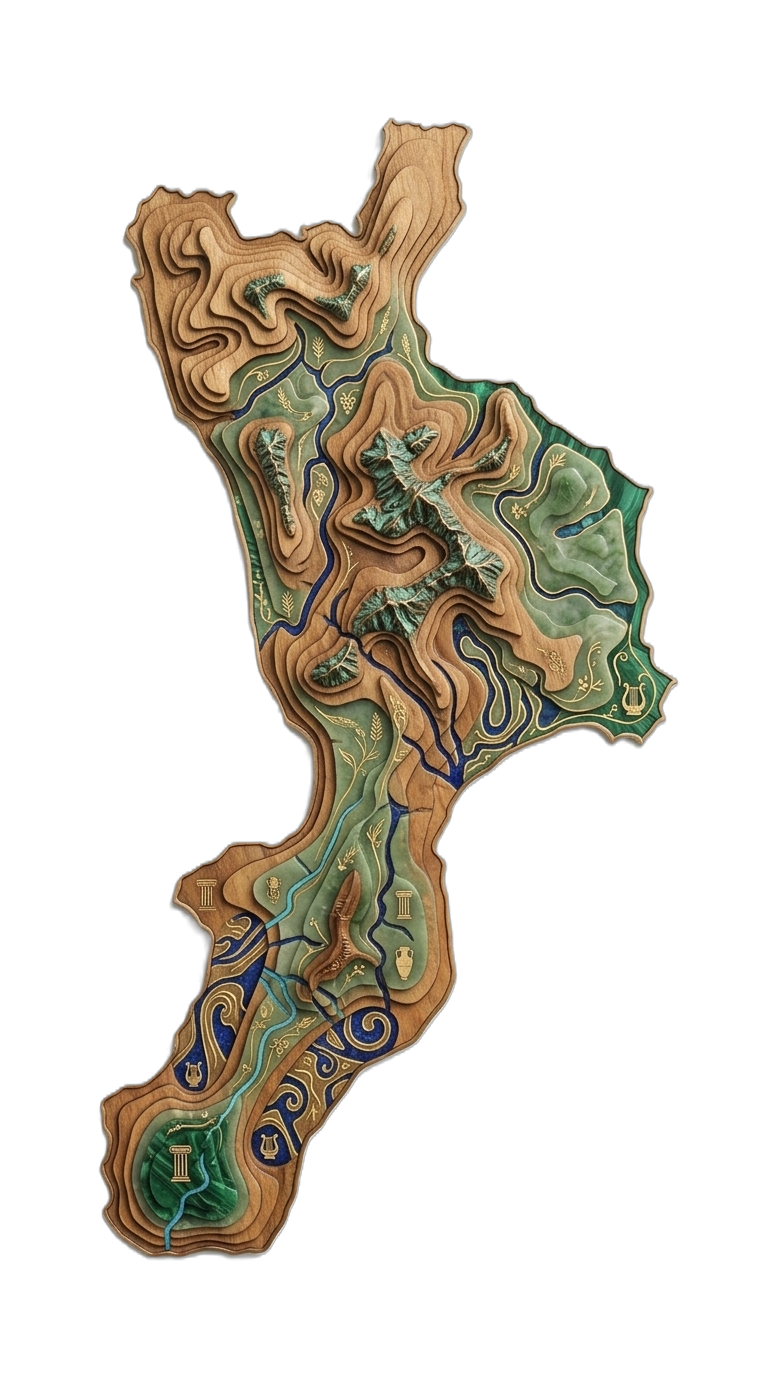
Select a Coast
Click any coast on the map above to explore its beaches, local flavors, and history.
Calabrian cuisine is a conversation between two seas. From the Tyrrhenian, the catch of the day — swordfish, tuna, sea urchin, clams. From the Ionian, the agricultural richness: citrus, olives, bergamot, wheat. And everywhere: the peperoncino, a red chilli so sacred it defines a regional identity.
So sweet it can be eaten raw or turned into jam. Hand-braided into trecce for natural curing.
The famous spreadable salame from Monte Poro. Pork fat and generous peperoncino, aged up to a year. It defines an entire cuisine.
Grows only on a narrow coastal strip near Reggio. Its essential oil is the soul of haute perfumerie; its bittersweet juice is now a culinary star.
Europe's first certified artisan gelato: a hand-shaped sphere of hazelnut and chocolate ice cream hiding a molten dark chocolate core.
The Amarelli family has extracted pure glycyrrhiza since 1731 — used by chefs in risottos, game reductions, and the purest pastilles in the world.
Scilla's signature: swordfish steaks braised with tomato, olives, capers, pine nuts, raisins, and Tropea onion — a symphony of the southern table.
Calabria is a palimpsest — Greek temples under Roman forums, Byzantine mosaics inside Norman walls, baroque masterpieces in mountain villages. The Bronzi di Riace, two of the finest surviving Greek bronzes, watch over Reggio Calabria. In the hills, the Certosa di Serra San Bruno and the Abbazia Florense carry a thousand years of contemplative silence.
A contemporary layer has emerged too: the Musaba at Mammola — Nik Spatari's visionary art park in a mountain monastery — and the MACA in Reggio, collecting Calabrian modernism. And the Borghi più Belli d'Italia dot the region: Morano Calabro, Civita, Cosenza's old town, each a living museum of Renaissance and Baroque beauty.
Two 5th-century BC Greek bronze warriors, perhaps the finest surviving examples of Classical sculpture. Warrior A with silver teeth, Warrior B in Polykleitan contrapposto.
A tiny Byzantine jewel: five cylindrical domes, brick walls, four recycled ancient columns, and frescoes spanning the 10th to 15th centuries.
Three cities on one site: Sybaris (720 BC), Thurii (444 BC, planned by Hippodamus), and Roman Copia — layered history in the Sibari plain.
A 6th-century illuminated Greek Gospel on purple parchment — gold and silver ink, lapis lazuli miniatures. UNESCO Memory of the World.
Norman foundation (1073), centuries of transformation: frescoed helical staircase, mirrored salon, intact 19th-century kitchens.
The world's second Carthusian monastery, founded in 1091 by Bruno of Cologne. Rebuilt after the 1783 earthquake, radiating centuries of silence.
Go beyond the overview
The homepage is the overview. Each topic page is the deep reference layer: still organized by coast, but built to answer what you can actually do from each base across Calabria.

Reference guide
Compare Calabria's beach coasts by water character, access style, and the kind of stay each one suits best.
Open the guide
Reference guide
See which coast puts cedro, bergamot, Tropea onion, wineries, mountain lunches, and producer detours within easy reach.
Open the guide
Reference guide
Find the coasts that best pair beach time with archaeology, villages, museums, castles, and art routes across Calabria.
Open the guide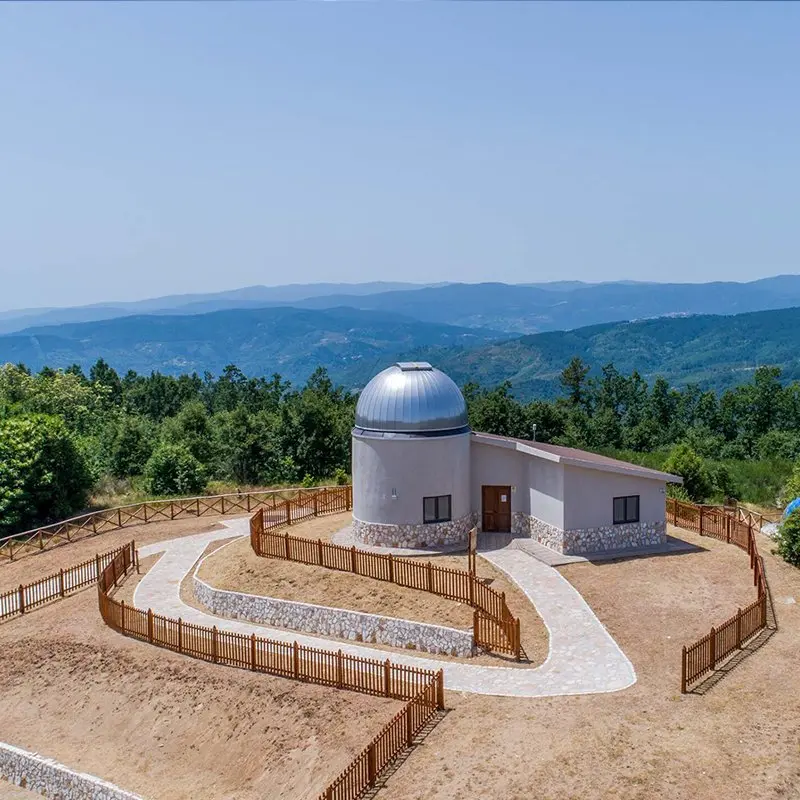
Reference guide
Use each coast as a different rhythm: beach clubs, promenades, rafting days, family attractions, festivals, or quieter village evenings.
Open the guide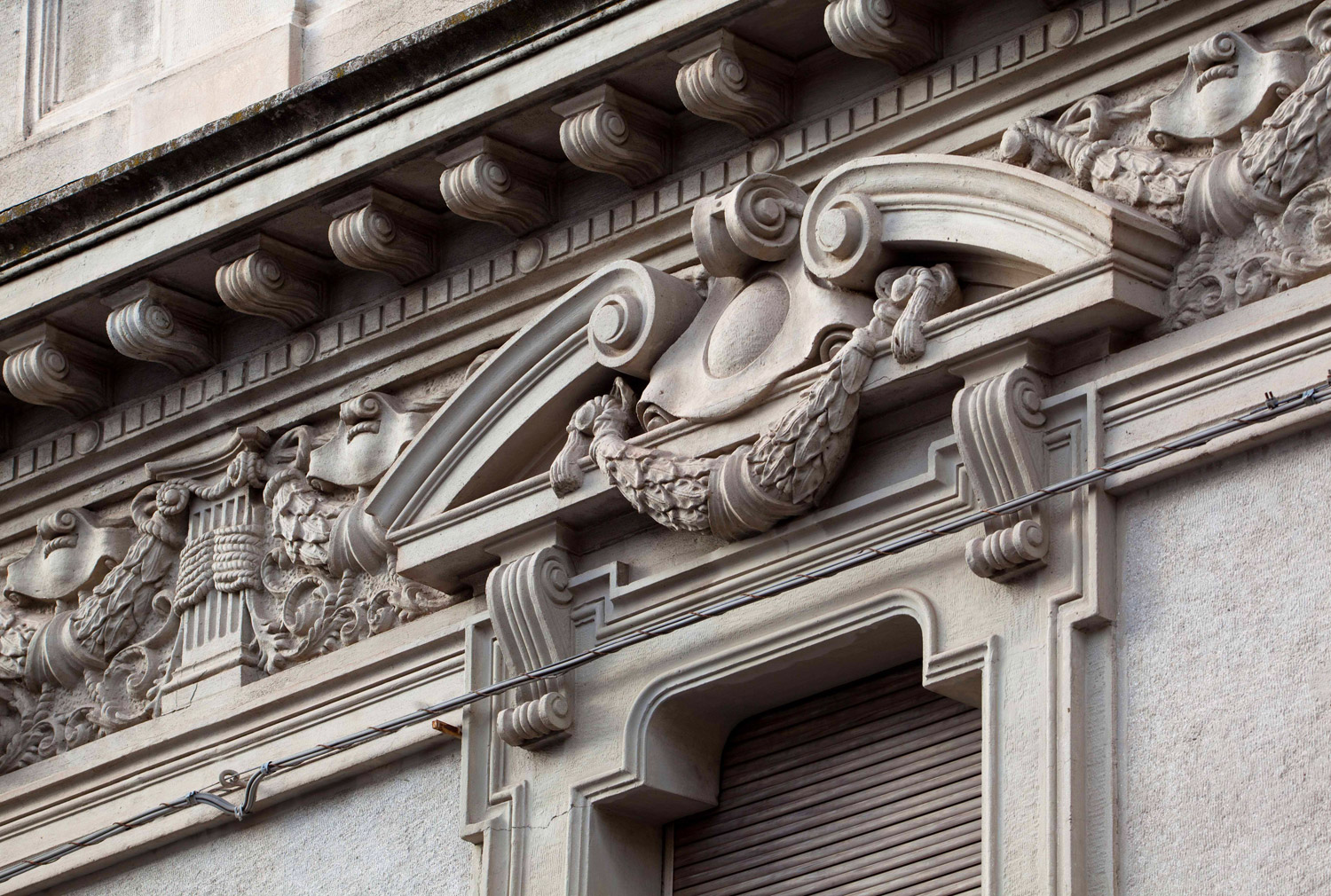
Reference guide
Choose the coast that best fits artisan detours, food-product buying, city shopping streets, or practical longer-stay errands.
Open the guide
Reference guide
Understand which coast gives you the right beach mechanics, weather flexibility, inland reach, and overall trip rhythm.
Open the guideMediterranean Winds
Calabria is a narrow peninsula — at its waist near Catanzaro, the two seas are barely 30 km apart. Ancient mariners named these winds: the Maestrale sweeping from the northwest, the Scirocco rising warm from Africa, the Tramontana descending cold from the mountains. Each carries a different character across the water.
The narrowest point of Calabria, near Catanzaro-Lamezia, places the two seas just 30 km apart — a geography that has shaped the region's culture, cuisine and character for millennia.